The forces reshaping how business buyers discover, evaluate, and choose. What it means for your brand strategy.
For a long time, many professional services firms and B2B organisations operated on a comfortable assumption: that brand was something consumer companies worried about. That expertise, reputation, and relationships were sufficient to drive growth. That a decent website and a consistent logo were enough.
That assumption is no longer safe. In 2026, the professional services and B2B landscape has shifted in ways that make strong, strategic brand investment not merely useful, but commercially essential.
The firms that understand this are pulling ahead. Those that don’t are increasingly difficult to distinguish from their competitors, regardless of how good their work actually is.
At Truly Deeply, we have worked with professional services firms, B2B companies, financial services businesses, industry associations, and corporate organisations across Australia and beyond for decades. This is what we see happening right now, and what it means for leaders considering their brand strategy.

The business case for brand investment has never been stronger
Let us start with the numbers, because in professional services, the conversation about brand investment often stalls at budget approval. Leaders want to know: what is this actually worth to the business?
The evidence is substantial. Research consistently shows that strong brands in professional services and B2B markets command premium pricing of between 10 and 30 per cent over weaker competitors. They achieve lower customer acquisition costs through stronger referral rates and organic discovery. They attract better talent, reducing recruitment spend and time-to-hire. And they convert more of the prospects they do reach, because buyers who already understand and trust your brand arrive with confidence rather than scepticism.
23%
Average revenue increase following a professional rebrand1
20%
How much strong B2B brands outperform weak ones2
5%
Buyers are in market at any given time. Brand builds your standing with the other 95%3
That last figure deserves particular attention. Research from B2B International confirms that only around five per cent of your potential clients are actively looking to buy at any point. The other 95 per cent are not in market yet, but they will be. The brands that are present, memorable, and positively perceived when those buyers eventually enter the market are the ones that get shortlisted without ever having to fight for it. Brand is not a marketing cost. It is a long-term commercial investment that compounds over time.
For professional services firms specifically, the professional services industry is projected to grow at a compound annual rate of 5.37 per cent through to 2029. That growth creates both opportunity and risk. A rising tide lifts all boats, but it also raises expectations. Clients have more choice, are better informed, and are more willing to switch providers than ever before. The firms that will capture disproportionate growth from this expanding market are those with brand equity to spare.
Brand is no longer a marketing asset. In 2026, it is the commercial spine that holds everything together. With so much of the buyer journey now happening before a salesperson is ever involved, your brand is your most important business development tool.

The forces making Brand more critical than ever
Several significant shifts are converging to make brand strategy a board-level priority for professional services and B2B organisations right now.
TREND 01
AI is rewriting how buyers find you
More B2B buyers are beginning their research through AI tools and chat-based search rather than traditional Google queries. If your brand is not clearly articulated, well-documented, and digitally consistent, you will not be surfaced. Discoverability now depends as much on clarity as on search engine rankings.
TREND 02
Risk aversion is rising among buyers
In an uncertain economic environment, business buyers are taking fewer risks. They prioritise firms that feel safe: transparent, reliable, demonstrably expert, and ethically aligned. A weak or inconsistent brand signals risk. A compelling, coherent brand signals confidence and trust.
TREND 03
Commoditisation is accelerating
As AI tools democratise access to knowledge and capability, the technical gap between competitors is narrowing. Research from The Branding Journal finds that unclear value propositions and crowded markets are the top brand challenges for B2B firms in 2026. Differentiation through brand is becoming more valuable, not less.
TREND 04
The buyer journey has changed permanently
McKinsey research shows B2B customers now use an average of ten interaction channels across their buying journey, up from five in 2016. Buyers are forming their views about your firm long before they engage with your team. What they find, and how it makes them feel, shapes the entire relationship.
Taken together, these forces mean that professional services and B2B firms can no longer rely on their networks and word of mouth to do all the heavy lifting. Brand must work harder, across more channels, and for an audience that is increasingly sophisticated in how it evaluates and selects providers.
The trap professional services firms fall Into
Ask almost any professional services firm or B2B organisation why they have not invested seriously in their brand, and you will hear a familiar set of responses. “We grow through referrals.” “Our clients know us.” “Our work speaks for itself.” “Brand is more of a consumer thing.” Sometimes: “We tried a rebrand once and it was mostly about the logo.”
These are not unreasonable observations. They just describe a past that is becoming increasingly less reliable as a guide to the future. Referral networks have a ceiling. The clients who know you will not always be in market. The decision-makers at your best clients change over time. And the competitors who are investing in their brand are making it easier and easier to switch.
The deeper issue is that many professional services and B2B organisations have never formally articulated what makes them genuinely different. They have a set of values on a website page, a tagline that sounds like every other firm in their sector, and a visual identity that has gradually accumulated inconsistencies over years of decentralised use. When pressed, their differentiation tends to be expressed through credentials, process, or service quality — all of which are claimed just as credibly by every competitor in the market.
A strong brand does not replace expertise or relationships. It amplifies them. It gives your firm a clear and compelling reason to be chosen that exists before any conversation with a salesperson or business development partner has taken place.
The common triggers we see
Professional services and B2B firms typically arrive at a brand conversation for one of several reasons: the business has grown or evolved beyond what the current brand represents; a merger, acquisition, or leadership change has created a need for a fresh strategic platform; the firm is entering new markets or targeting new client segments; talent attraction has become a significant challenge; or the brand simply feels dated and is no longer doing the firm justice in a competitive pitch.

Brand Strategy, not just Brand Identity
This is perhaps the most important distinction for any professional services or B2B leader to understand before embarking on a brand project. Brand strategy and brand identity are not the same thing, and the most expensive mistake an organisation can make is to invest in the latter without doing the former.
Brand strategy is about defining who you are, what you stand for, how you are genuinely different, and why that matters to the clients and talent you are trying to attract. It requires honest research, stakeholder consultation, and the discipline to make real choices about positioning. It produces a brand proposition that is compelling, differentiated, and authentically grounded in the organisation’s actual strengths and culture.
Brand identity — the visual language, the naming, the logo, the design system — is the expression of that strategy. A new visual identity without a strategic foundation underneath it will look different, but not be different. And within months, the organisation will revert to communicating in the same undifferentiated ways as before, because there is nothing clear and compelling driving the communication.
The professional services and B2B firms that get the most from their brand investment are the ones that treat brand strategy as a genuine business priority, not a creative project delegated to marketing.

Case Study
Wotton Kearney — Rebranding Asia Pacific’s leading insurance law firm
Founded in 2002, Wotton Kearney had grown from two partners to 86 partners and more than 700 team members across offices in Australia, New Zealand, and Singapore. But as the firm’s capabilities expanded well beyond its original insurance law specialism into emerging risks, innovation, AI, and Asia, the brand had not kept pace with the business it had become. Truly Deeply consulted with the firm across Asia Pacific through workshops, surveys, and sessions with firm leaders and cultural champions to understand what WK truly meant to its clients and people. The resulting brand essence — big thinkers, trail blazers, impactful humans — captures the firm’s culture of solving complex challenges, its commitment to innovation, and its global ambitions. A bold monogram identity, anchored by forward-moving chevron elements, gave visual form to an organisation that had genuinely outgrown its previous brand.

Differentiation is everything when everyone claims the same
Professional services and B2B markets are, almost without exception, crowded with firms making very similar claims. Every law firm promises client-centred service and deep expertise. Every consulting firm offers strategic insight and measurable outcomes. Every financial services business talks about trust, partnership, and long-term thinking. Every industry association exists to advocate for its members and strengthen the sector.
When the category language is that uniform, winning the right clients becomes almost entirely a function of price, timing, and who the buyer happened to hear about most recently. None of those are positions of strength.
The brands that break out of this pattern do so not by making louder versions of the same claims, but by finding a genuinely distinctive point of view. This usually requires looking inward before looking outward — understanding what the organisation’s people actually believe, how they actually work, and what the clients who value them most actually value about the relationship. That distinctive truth, properly articulated and consistently expressed, is the foundation of a brand that commands attention and commands premium pricing.

Case Study
Arca — Rebranding Australia’s leading credit industry association
Arca is the industry association that brings together Australia’s leading credit providers and reporting bodies. Despite delivering genuine value to its members, the brand was widely perceived as limited in reach, confusing to external audiences, and underselling its influence and expertise. Research identified that the organisation’s people and performance were its strongest assets, but the brand was failing to reflect them. Truly Deeply developed a new strategic proposition built around the idea of “together for credit confidence” — a positioning that captured Arca’s genuine differentiator: the unifying, collaborative role it plays in a complex industry landscape. The brand name was simplified from its full title to Arca, written in title case, and a new brand architecture was developed to bring greater clarity to the organisation’s consumer-facing Credit Smart service.

Case Study
Foresters Financial, A 175-year-old brand transformed for growth
Foresters Financial has been generating wealth for clients since 1849, but the brand had remained largely focused on its traditional funeral investment bond audience, limiting its appeal and commercial growth potential. With a new business strategy and ambitious targets for reaching a much broader investor market, the organisation needed a brand transformation to match. Partnering with the leadership team and Board, Truly Deeply developed a new strategic brand proposition anchored in the promise of “empowering prosperity, protecting legacies.” This leveraged the brand’s extraordinary heritage while firmly repositioning it for contemporary audiences. A new visual identity reimagined the original crest and stag horn iconography of the 1849 founders in a sophisticated, forward-looking mark that speaks to both history and ambition.
When your Brand is holding the business back
One of the most valuable things a brand audit can reveal is the gap between how an organisation sees itself and how its clients, prospects, and potential employees actually perceive it. In professional services and B2B markets, this gap is often wider than leaders expect, and it is almost always costing the business.
A brand that is perceived as dated creates doubt about the organisation’s relevance and forward-thinking capability. A brand that is misunderstood or poorly differentiated means that even satisfied clients struggle to describe why they chose you, making referrals less frequent and less targeted. A brand that fails to attract the right talent increases recruitment costs and cultural drift. And a brand that does not accurately represent the full scope of the organisation’s capabilities will consistently miss cross-selling and new market opportunities.
The Spective case is instructive here. A business does not need to be failing to need a new brand. It just needs its brand to be telling the wrong story.

Case Study
IND rebrands to Spective. When a strong business outgrows its brand
IND Window Fabrications had built a strong reputation as a specialist in windows and facades, but the business had evolved to offer comprehensive solutions across facades, steel structures, building products, claddings, and full project management from design through to installation and maintenance. The name and brand told only a fraction of the story. Audience research confirmed that while clients held the organisation in high regard, the brand was actively holding the business back: it was not memorable, did not reflect the breadth of services, and created confusion through similarity with another company’s name. Truly Deeply conducted a strategic naming process and brand development programme that resulted in a complete transformation: a new name, Spective, expressing the company’s true identity and forward-looking purpose, a new brand strategy built from the inside out, and a striking visual identity reflecting the structural intelligence at the heart of the business. The result was immediate: long-term employees were reinvigorated, and client perceptions shifted measurably.

Brand Architecture for complex professional services organisations
Many professional services and B2B firms carry complexity that goes beyond a single brand. Multi-disciplinary practices, firms with distinct product lines or service divisions, and organisations that have grown through acquisition often face a brand architecture challenge before they can tackle positioning and identity.
The question is not just “what should we look like?” It is “how do our different offerings, divisions, or acquired businesses relate to each other under a coherent brand structure?” Getting this wrong leads to confusion in the market, internal inconsistency, and fragmented client experience. Getting it right creates a brand ecosystem where the parts reinforce each other and the whole is greater than the sum.
For B2B organisations navigating mergers, acquisitions, or significant expansion, brand architecture strategy is often the most consequential decision in the entire rebrand. It shapes every communication decision that follows for years to come.
Case Study
Vinyl Group — Building a unified and scalable brand from merged businesses
When three separate music technology businesses — Vampr, Jaxsta, and Vinyl.com — merged in 2023, the new entity faced a challenge familiar to many B2B organisations after M&A activity: how to protect and leverage the equity in three existing brands while creating something coherent and commercially compelling as a group. Truly Deeply worked with the ownership team to develop a brand architecture strategy, a new group brand name, a strategic proposition, and a visual identity system that united the three businesses without erasing their individual identities. The Vinyl Group brand, built around the purpose of “being the heartbeat of an equitable music world,” gave investors, industry partners, and users a clear and compelling reason for the combination to exist.
Brand as a platform for growth, capital, and talent
For B2B organisations at an earlier or more dynamic stage of growth — scale-ups, private equity-backed businesses, and challenger firms entering established markets — brand is not just a communications tool. It is a growth platform and a signal of credibility to the capital markets, commercial partners, and senior talent that the business needs to attract.
In private equity and investment, brand clarity is increasingly recognised as a value driver. A well-articulated brand proposition gives investors confidence in the business model, the management team’s clarity of vision, and the organisation’s ability to execute. It also accelerates the commercial momentum that justifies valuation.
Similarly, in competitive talent markets where the best people have choices, a compelling employer brand is inseparable from the overall organisational brand. The professional services and B2B firms that are winning the war for talent in 2026 are those that can articulate not just what they do, but why it matters, what working there actually feels like, and what values drive the organisation day to day.

Case Study
Straight Bat — Branding a new-breed private equity fund from the ground up
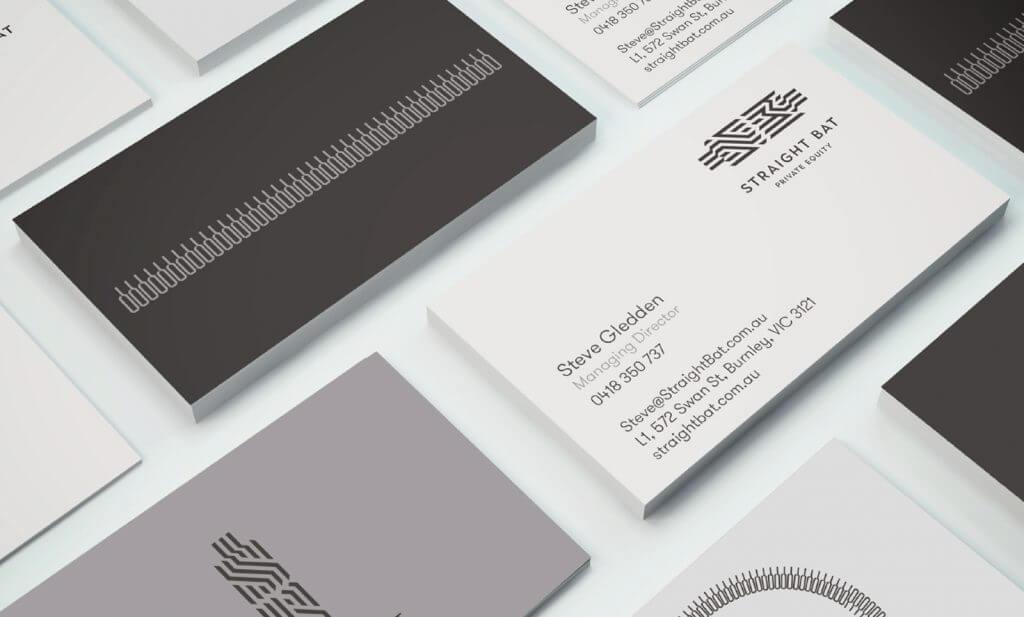
Straight Bat is a private equity fund with a genuinely differentiated model: long-game investing focused on family-owned businesses, enabling founders to achieve a smooth transition while preserving their legacy and realising the returns of a lifetime’s work. In a mature PE market dominated by established incumbents, the brand had to do real commercial work from day one. Truly Deeply worked with the Straight Bat leadership team to translate a distinctive business model into a compelling brand proposition, a unique brand voice and narrative, and a visual identity that was both evocative and strategically appropriate for the firm’s target audience. The resulting brand gave Straight Bat the credibility, clarity, and distinctiveness to compete immediately in a crowded market, without looking or sounding like any of its competitors.
What makes a successful professional services rebrand
Drawing on our work across law firms, financial services businesses, industry associations, B2B companies, and corporate organisations, there are clear patterns in the professional services rebrands that deliver lasting commercial results.
Leadership ownership. The most successful rebrands are those where the CEO, managing partner, or managing director is genuinely committed to the process and its outcomes. Brand strategy is a business strategy conversation. It should not be delegated entirely to marketing.
A genuine willingness to differentiate. Many professional services firms start a brand process hoping it will confirm what they already believe about themselves. The organisations that benefit most are those willing to hear uncomfortable truths from their clients, their people, and their market, and then act on what they learn.
Strategy before identity. Investing in a new visual identity without a clear strategic foundation is the most common and costly mistake in professional services branding. The brand identity must express a clear and differentiated proposition. Without one, you are investing in aesthetics, not brand equity.
Internal engagement from the start. In professional services particularly, your people are the brand. Partners, directors, and senior practitioners all have views on what the firm stands for and how it should present itself. Engaging them early creates advocates rather than critics when the new brand is launched.
A commitment to activation. A brand that lives only in a guidelines document is not a brand. The organisations that see the greatest return on brand investment are those that roll it out with commitment, invest in internal culturalisation, and give their people the tools and the conviction to deliver on the new proposition every day.
In 2026, the B2B and professional services firms that stand out are those with a clear and compelling point of view about who they are and why it matters. In markets saturated with AI-generated sameness, authenticity and genuine differentiation are not brand ideals. They are commercial advantages.
Truly Deeply has built and rebranded professional services firms, B2B organisations, financial services businesses, and industry bodies across Australia and internationally. We understand the commercial pressures, the stakeholder complexity, and the culture of organisations where expertise and relationships sit at the heart of the business model.
If your brand is not doing justice to your organisation’s capabilities, or you are at a strategic inflection point that demands a rethink, we would welcome the conversation.
Let’s talk about your brand.
We’d be happy to work through your challenges, explore your opportunities, and recommend the best path forward for your organisation.
Get in touch with Truly Deeply
Michael Hughes
Michael is Managing Partner and Strategy Director at Truly Deeply. His deep expertise is building stakeholder alignment, unlocking insights, and defining the strategic power of your brand to create a differentiated, compelling, and authentic brand proposition that will engage all your audiences and drive your business growth. Michael has extensive experience working with leading Australian and International organisations across just about every sector.
References
- Lucidpress and Demand Metric, The Impact of Brand Consistency.
- McKinsey, B2B Business Branding.
- B2B International, 9 Trends That Will Shape B2B Brands in 2026.